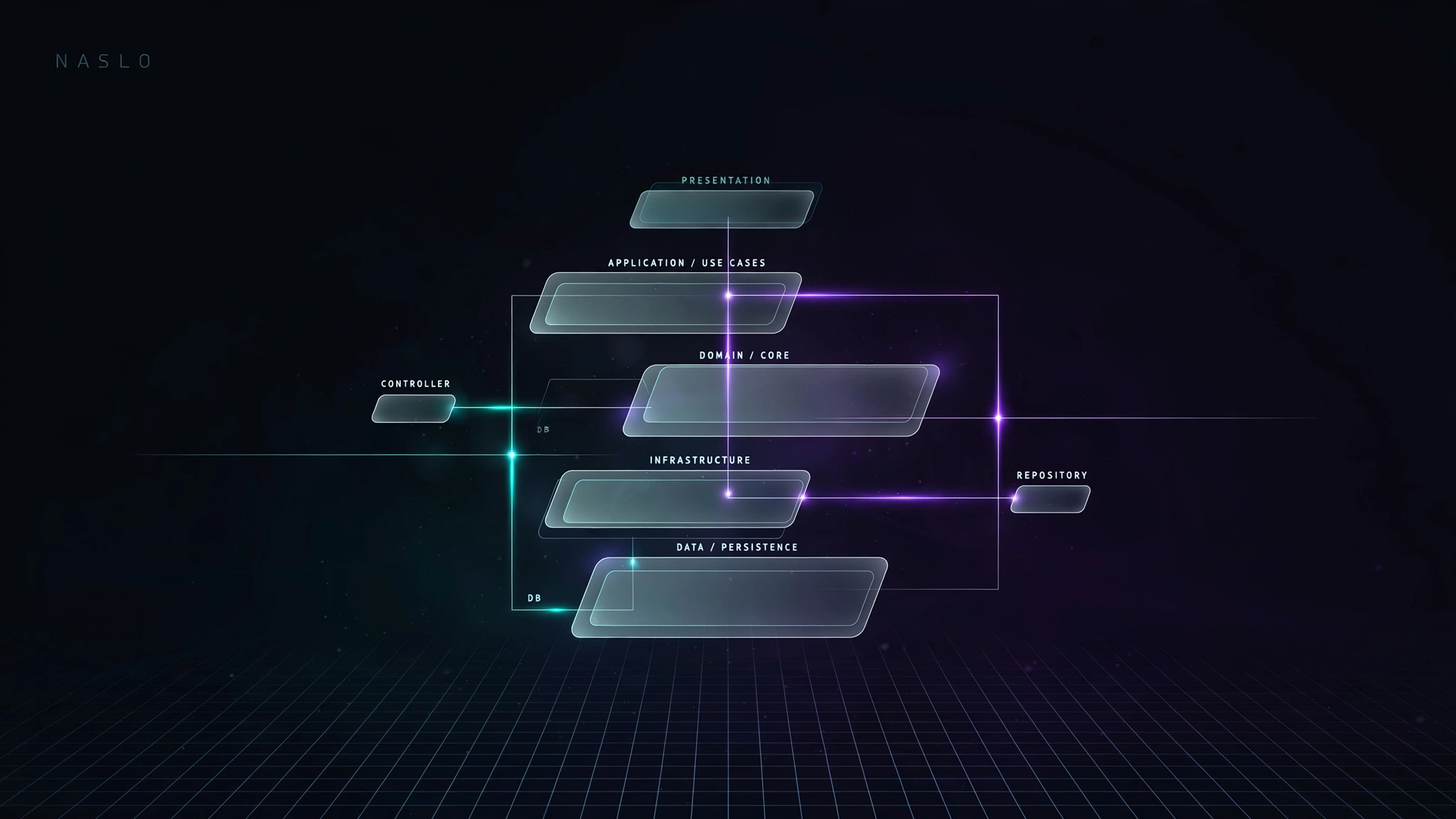
Naslo is the internal codename for SewTec's next-generation e-commerce platform — a full rebuild of their Shopify storefront (sewtecstore.com) into a custom Arabic-first system for industrial sewing machines and spare parts. I'm the backend architect and full-time software engineer on it.
The platform serves three distinct purchase journeys: retail guest checkout with fixed prices, dealer quote requests (no fixed prices — negotiated per order), and production-line requests. This three-way split drives every backend design decision.
Business Analysis: Three Journeys, One Platform
Before writing a line of backend code, the business domain had to be mapped. SewTec doesn't sell like a normal store — the same catalog behaves completely differently depending on who's buying:
The 8 Open Questions
The backend analysis doc (PR #4) identified 8 business questions that must be answered before data/API design can begin. They're business questions, not technical ones — the answers live with SewTec's sales and warehouse teams:
Q-01: First-release scope — which journeys ship in v1?
Q-02: How is stock managed today? (No real-time stock in v1 — manual confirmation)
Q-03: Who approves dealer eligibility, and on what basis?
Q-04: After a quote request — converted to order, or negotiated offline?
Q-05: Who sets prices? How is shipping computed per region?
Q-06: Payment providers (COD + bank transfer at launch)
Q-07: Multi-brand catalog ownership and spare-part compatibility
Q-08: Production-line request workflow
▶Why these questions block the backend
Every one of these maps to a bounded context or aggregate boundary. Q-04 (quote-to-order flow) decides whether Quote and Order are one aggregate or two. Q-02 (stock) decides whether Inventory is a real-time aggregate or a manual process. Getting these wrong means rebuilding the domain model later.
The doc's advice: answer Q-01 first (scope), then Q-02 and Q-04 (current process). The rest get easier.
System Architecture
The system is split into two deployables: a Next.js frontend (client-rendered, Arabic RTL) and a .NET backend (planned: .NET Aspire, Clean Architecture, CQRS with MediatR). The frontend currently runs on mock data + localStorage — the backend contract is being designed to replace it without frontend rewrites.
Frontend Layering (built)
The frontend follows strict layering — domain/ owns types and never imports from other layers. The storefront section system is a textbook example:
The section registry uses an exhaustive switch with a never guard — the compiler rejects a new section type until every layer handles it. The type system enforces the architecture.
Backend Design (in progress)
The backend follows Clean Architecture with CQRS. Here's the pattern for the dealer quote flow — the most complex journey:
Key design decision: a Quote is NOT an Order. It's a separate aggregate with its own lifecycle (Requested → UnderReview → Approved/Rejected → ConvertedToOrder). Merging them would have been simpler short-term but wrong — the business treats them as different things with different actors (dealer vs sales team).
Domain-Driven Design: The Catalog Problem
SewTec sells machines AND spare parts across multiple brands (ZOJE, Jack, Siruba...). A spare part isn't just a product — it's compatible with specific machine models. This is a classic DDD aggregate design problem:
The naive approach — a flat product table with a 'compatible_with' text field — breaks the moment you need to answer 'which parts fit this machine?' at scale. The compatibility relationship deserves its own model.
Dual Pricing: The Hardest Domain Problem
Guests and retail accounts see fixed prices. Dealers see NO prices — they request quotes. This isn't a UI toggle; it's a domain invariant:
Returning null for dealers (not zero, not hidden in the UI) makes the invariant explicit in the domain layer. The frontend can't accidentally show a dealer a price — there's no price to show.
Current Status
Frontend: Next.js 16, 7 section types, studio editor with undo/redo, draft/published workflow — live in preview
Backend analysis: 8-phase doc complete, 8 business questions identified, awaiting operational validation
Backend implementation: Clean Architecture + CQRS design in progress, starting with the quote aggregate
Next: answer Q-01 through Q-04 with the sales team, then data model + API contract
This page grows with the project. As phases complete — data model, API contract, first deploy — they'll be documented here with the same depth.