
Introduction
Have you ever wondered what actually happens when you press dotnet run or hit F5 in Visual Studio?
C# is often described as a "high-level managed language", but under the hood, it executes code with performance approaching bare-metal C++. To truly master .NET performance, diagnose latency spikes in production, or ace senior-level system architecture interviews, you must understand the journey your code takes from high-level C# syntax down to CPU machine instructions.
In this comprehensive guide, we will explore:
The Compilation Pipeline (Roslyn vs CLR)
The First-Call Mechanism (Method Tables & Trampolines)
Tiered Compilation (Tier 0 vs Tier 1)
Dynamic PGO (Profile-Guided Optimization)
On-Stack Replacement (OSR)
Production Deployment Strategies (ReadyToRun vs Native AOT)
1. The Compilation Pipeline: Roslyn vs. The CLR
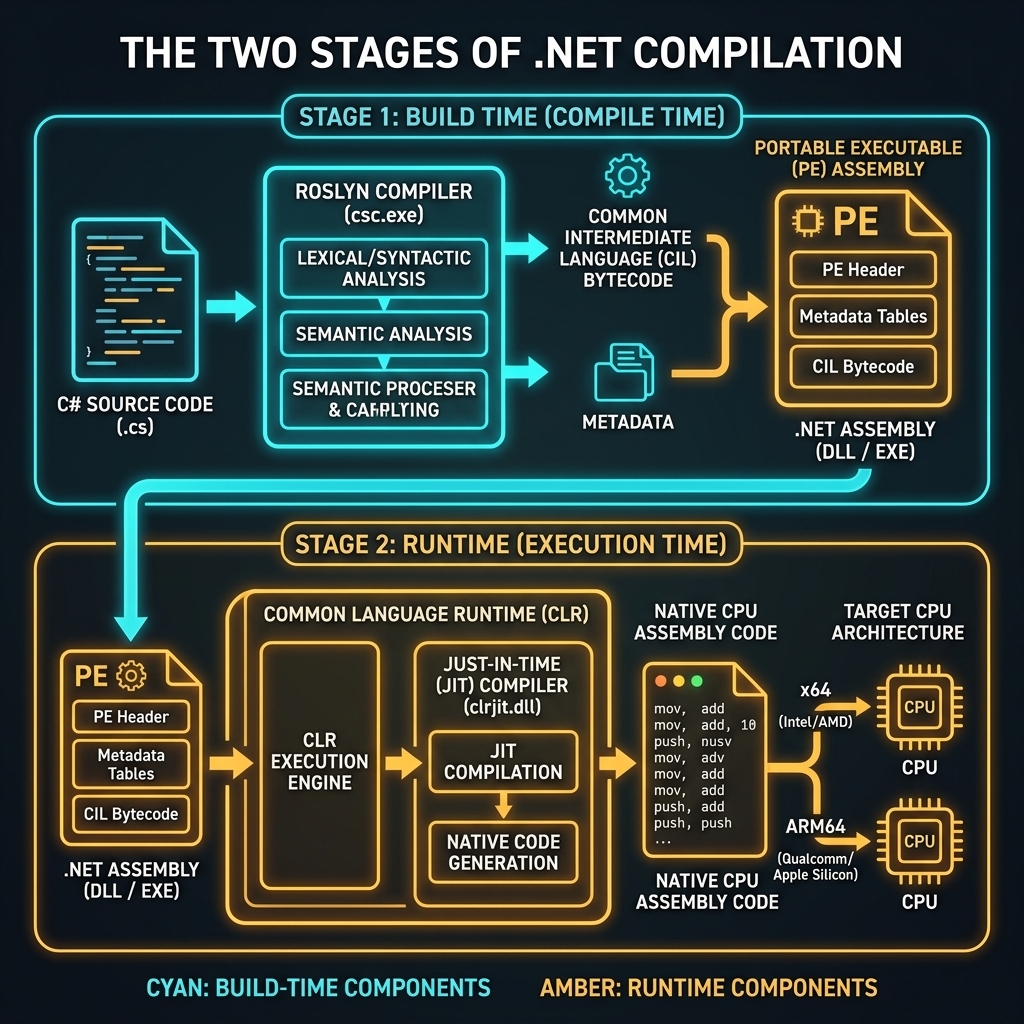
When you compile a C# application, compilation happens in two distinct stages:
Stage 1: Build Time (Roslyn - csc.exe)
Role: Parses syntax, performs semantic type checks, and translates high-level C# into Common Intermediate Language (CIL) bytecode.
Output: A Portable Executable (PE) file (
.dllor.exe) containing:CIL Bytecode: An OS-independent instruction set for a virtual stack machine.
Metadata Tables: Describes every class, struct, method, property, and assembly reference.
Key Fact: Roslyn does NOT produce CPU machine code. Its output is 100% OS and CPU architecture agnostic.
Stage 2: Runtime (The Common Language Runtime - CLR)
Role: The virtual machine environment that manages execution, type safety, Garbage Collection (GC), and thread dispatching.
JIT Compiler (
clrjit.dll): Takes OS-independent CIL bytecode and translates it into OS-native machine code for the specific CPU architecture (x64, ARM64) running the application.
2. Under the Hood: The First-Call Trampoline Mechanism
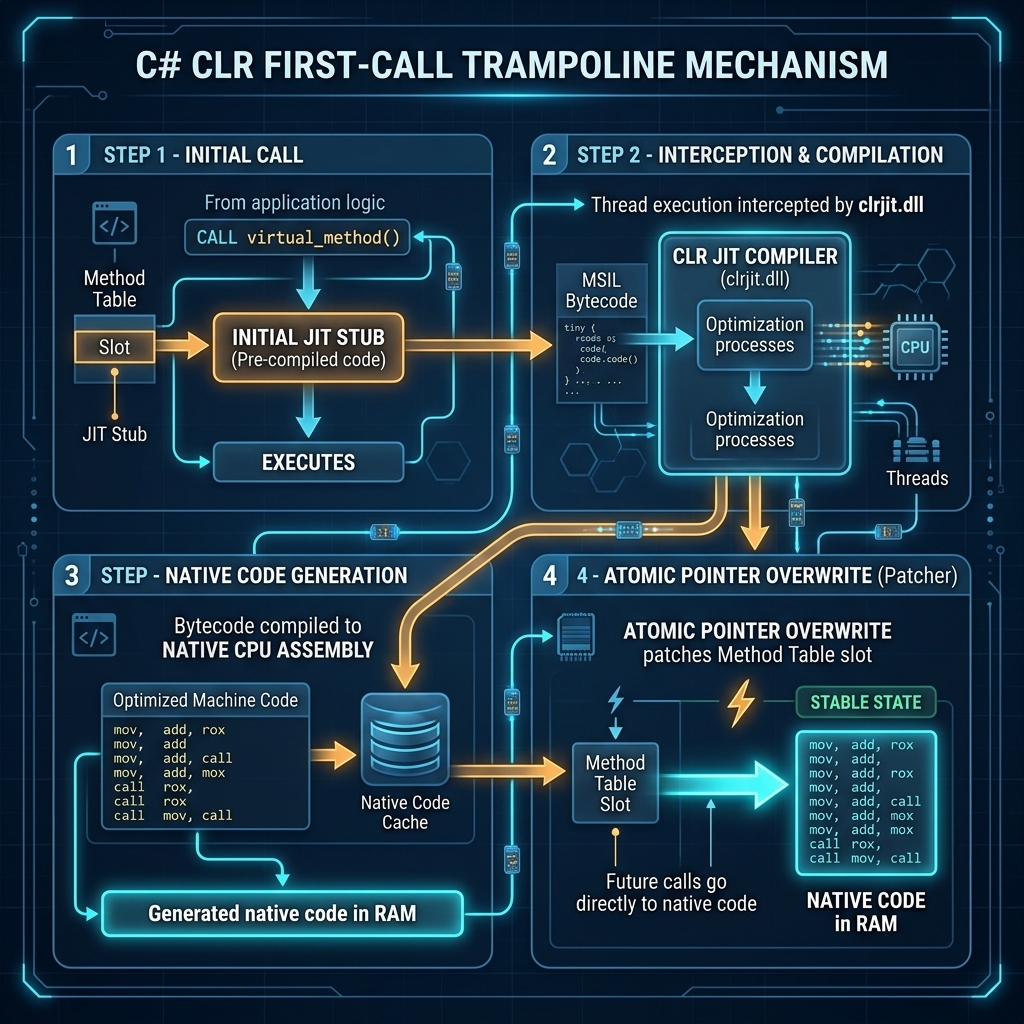
When an application boots up, zero CIL bytecode is compiled into native CPU machine code.
How does the CLR compile methods only when they are needed without slowing down the entire application?
Step-by-Step Mechanics:
Method Table Construction: When a type is loaded into memory, the CLR creates a Method Table (Type Descriptor).
The Trampoline Pointer: Initially, every method entry in the Method Table points to a small runtime helper called a JIT Trampoline Stub.
First Call Interception: When
Execute()is called for the first time, the thread jumps to the Stub, which pauses execution and callsclrjit.dll.Compilation & Allocation: The JIT reads the CIL bytecode, compiles it into native CPU assembly, and stores it in executable RAM.
Atomic Slot Patching: The JIT atomically overwrites the pointer in the Method Table. Future calls jump straight to the native assembly address with zero JIT latency.
3. Tiered Compilation & Dynamic PGO (.NET 8/9/2026)
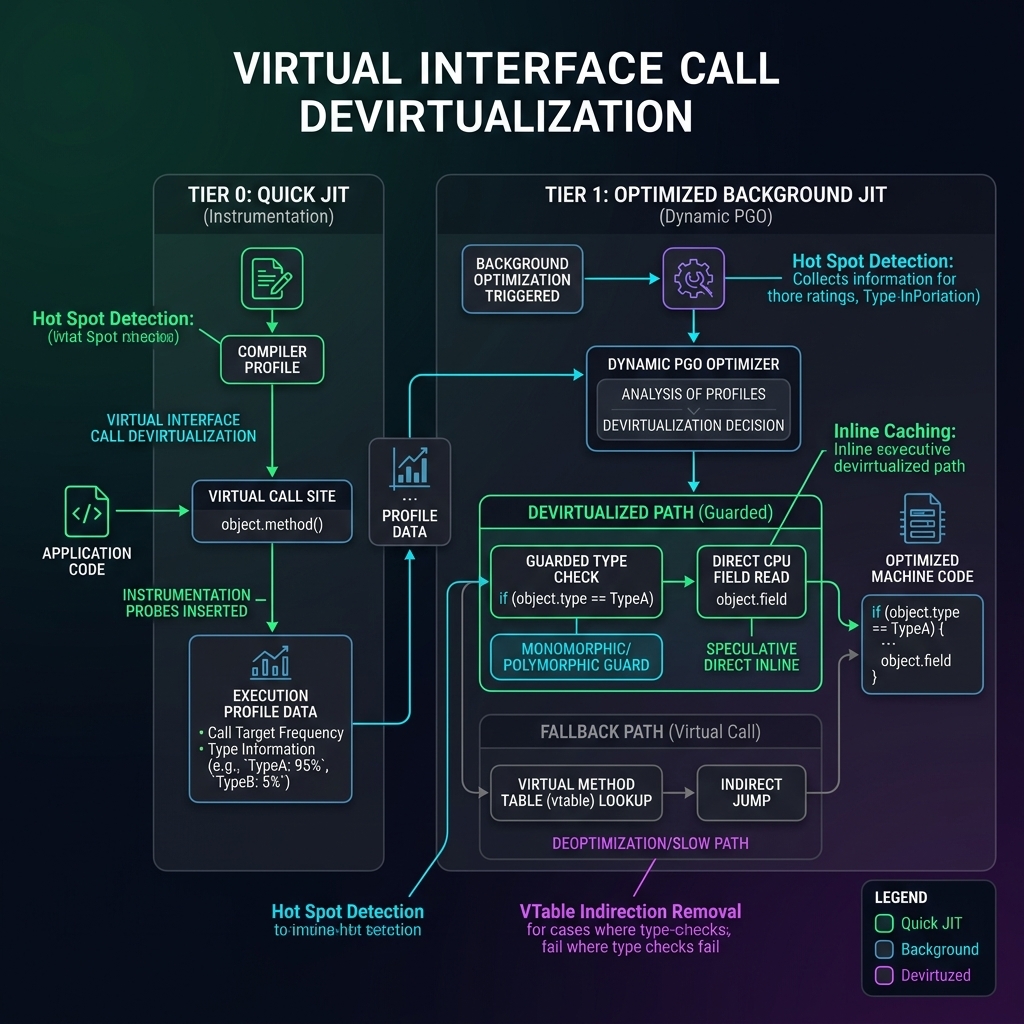
To balance application startup speed vs peak steady-state throughput, modern .NET uses Tiered Compilation paired with Dynamic Profile-Guided Optimization (PGO).
Tier 0 (Quick JIT / MinOpts)
Goal: Fast startup.
Mechanism: Compiles CIL to native code in microseconds by skipping heavy optimizations (no loop unrolling, minimal inline expansion).
Instrumentation: Injects lightweight counters and probes into the code to measure execution paths and concrete runtime types.
Tier 1 (Optimized JIT)
Goal: Maximum steady-state performance.
Mechanism: When a method becomes "hot" (frequently called), a background thread re-compiles the CIL using aggressive compiler optimizations (SIMD vectorization, loop unrolling, method inlining).
4. The Magic of Dynamic PGO: Interface Devirtualization
Consider this standard C# code:
Without PGO (Traditional Interface Dispatch):
On every iteration, calling items.Count requires a Virtual Stub Dispatch (VSD):
Dereference object pointer to get
MethodTable*.Scan Interface Map for
IList<int>.Perform an indirect jump (
call [rax + 0x30]).Result: 3 memory dereferences per item, no compiler inlining, and CPU branch predictor pipeline stalls.
With Dynamic PGO (Tier 1 Transformation):
The Tier 0 probes discover that 99.9% of the time, items is a List<int>. Tier 1 JIT transforms the assembly into the equivalent of this C# code:
5. Mid-Execution Optimization: On-Stack Replacement (OSR)
What happens if a method is called only once, but contains a loop that runs 1,000,000 times?
Without OSR, because the call count is 1, the method would stay trapped in slow Tier 0 code for minutes.
.NET Solution: On-Stack Replacement (OSR)
The JIT tracks loop backedge iterations inside Tier 0.
When the loop hits a threshold (e.g., 1,000 iterations), Tier 1 compiles in the background.
The CLR pauses the thread at the loop boundary, replaces the active stack frame (On-Stack Replacement), and resumes execution mid-loop inside Tier 1 native assembly!
6. Production Deployment Strategies: ReadyToRun vs. Native AOT
When deploying high-throughput microservices to cloud environments (like Kubernetes), you must choose the right compilation strategy to avoid JIT Cold-Start Latency Spikes.
Architectural Trade-off Matrix
Feature | Standard JIT | ReadyToRun (R2R) | Native AOT |
|---|---|---|---|
Compilation Time | Runtime (On demand) | Build Time + Runtime | 100% Build Time |
Startup Speed | Slow (JIT overhead) | Fast (Pre-compiled) | Instant (< 10ms) |
JIT Compiler Present? | Yes | Yes (Full CLR active) | No |
CIL Present in DLL? | Yes | Yes | No |
Reflection Support | 100% Full | 100% Full | Restricted / Trimmed |
Dynamic Code Gen | Supported | Supported | Not Supported |
Memory Footprint | Moderate | Moderate | Minimal (Lowest RAM) |
Summary Cheat Sheet for Architecture & Interviews
Roslyn (
csc.exe) compiles C# into OS-agnostic CIL bytecode + Metadata stored in a PE assembly.CLR JIT (
clrjit.dll) compiles CIL into CPU-native machine instructions at runtime.First-Call Trampoline: Method Table slots initially point to stubs. Upon first execution, the JIT compiles the bytecode and atomically overwrites the slot pointer with the native RAM address.
Tiered Compilation: Tier 0 compiles fast without optimization; Tier 1 re-compiles hot methods with heavy optimizations on background threads.
Dynamic PGO: Uses live execution probes to perform Guarded Devirtualization, turning slow interface VTable lookups into inlined direct memory reads.
OSR (On-Stack Replacement): Swaps an executing thread's stack frame mid-loop to upgrade long-running loops from Tier 0 to Tier 1 code.
ReadyToRun (R2R) bakes pre-compiled native code into DLLs while keeping full CLR features. Native AOT compiles directly to a standalone native binary without CIL or a JIT compiler.